|
|
On our journey in life, the most profound thing that we can offer others--partners, children, parents, friends, co-workers, bosses, neighbors--is our own healing and growth towards being a more loving person.
|
|
|
 "We are all little lighthouses, and we are beaming and telegraphing information all the time. The clearer, cleaner, more peaceful, more joyful we are, the greater is the light." These words were spoken by Iyanla Vanzant, inspirational speaker, author, life coach, and certified tapping practitioner recently during the 16th World Tapping Summit. The title of her presentation was "Healing Ancestral Shadows: Using Tapping to Break Generational Chains."
Ms. Vanzant further explained that through scientific studies in epigenetics, we now know that just as we inherit physical traits from our ancestors, we also carry the emotional and spiritual imprints of generations past. From our mothers' hearts to our fathers' voices, their spirits weave into the very fabric of our being. Living with irrational fears and triggers that stem from our ancestors' experiences can leave us feeling trapped. But we are not broken. We carry the wisdom of generations, and with compassion, we can free ourselves, our families, and our ancestors from the burdens of the past. Tapping, also known as EFT (Emotional Freedom Technique), is a powerful stress relief technique. It is based on the combined principles of ancient Chinese acupressure and modern psychology. It is a tool that I use for myself and in my coaching practice. It is such a simple method that only requires the use our hands and our voice. With each tap, we honor the wisdom of our ancestors and create space for healing and growth. Instead of blaming or holding onto resentment, embrace forgiveness as a path to liberation. Acknowledge the struggles of our ancestors and celebrate the resilience that brought us here today. By letting go, we pave the way for healing, not just for ourselves but for future generations. Host of the program, Jessica Ortner said that if someone asked her how do we work toward world peace, she would say that we need tapping to better manage our own emotions as well as heal the generational wounds and pain. How much better can we impact those around you when we are able to be a lighthouse, radiating peace, joy, and love into the world? To watch the presentation with Iyanla Vanzant and Jessica Ortner: youtu.be/-oRce2UdsOk?si=UODdp9IyWf--lyjK To learn more about tapping: www.thetappingsolution.com/ 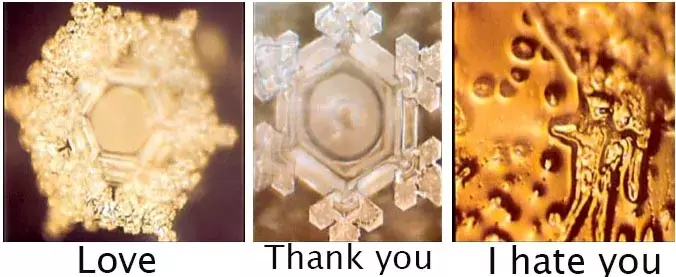 Every word we speak has energy and power--the power to hurt or heal. Dr. Masaru Emoto was a pioneer in the study of water. Through his numerous experiments, he discovered that the human vibrational energy of thoughts, words, ideas, and music affects the molecular structure of water. For over 20 years until he passed away in 2014, he studied the scientific evidence of how the molecular structure in water transforms when it is exposed to human words, thoughts, sounds and intentions.
Since an adult human body is made up of 70 % water, imagine the impact that words have on ourselves and each other. Dr. Emoto also demonstrated how polluted and toxic water, when exposed to prayer, meditation, positive words, and intentions, can be altered, and restored to beautifully formed geometric crystals as found in clean, healthy water. www.youtube.com/watch?v=1qQUFvufXp4 As a Safe Conversations facilitator, I teach individuals and families about a new way of understanding our relationships--it is two people and the space between them. What we put into that invisible space--complaint and negativity or appreciation and understanding--greatly impacts the quality of our relationship with each other. Of course, this must include our relationship with ourselves; the words that we think and say about ourselves have the power to directly affect our emotional state. Speaking words of grace, appreciation, kindness and empathy to ourselves and those that we care about creates connection, wonder, joy and love in our families and beyond. For more on the Space Between: steps-to-cultivating-family-communication-and-connection-the-space-between.html For more on the impact of negativity: the-impact-of-negativity.html  On Valentine's Day, it is estimated that 250 million stems of flowers and thirty-six million boxes of heart-shaped chocolates are given globally. It is the official day to declare our love and it comes with a lot of expectations. While I appreciate flowers and chocolates, my husband, Michael, and I have been practicing giving when it is unexpected. This relates to the understanding of unconditional love that we are learning as we study the many books on Real Love by Dr. Greg Baer. He has said, "When your desire is to love others with all your soul, instead of looking for what they can do for you, you're becoming a holy person."
Giving to others doesn't have to cost a lot. Yesterday, Michael and I went to a historic estate and gardens, and I found this beautiful heart created with fallen blossoms. Someone, perhaps a child, took the time to make the heart in order to brighten the day for others. Giving love can be some words of encouragement to a busy cashier at your local grocery store. It could be buying a gift card for a couple whose budget is tight so they can enjoy a meal out together. Maybe it is offering to watch your son or daughter's children for a few hours. Or it might be appreciating the work that someone at your church, community or workplace does, telling them that you notice their investment. When I was a young child, we moved across the country from Indiana to Oregon where my dad began his journey as a pastor. We were far from friends and family, and we received support and love from several older single women in our new church community. They realized that my parents didn't have a dryer; my mom had been used to hanging everything out on the clothesline. Given Oregon's many rainy days, they purchased us a dryer. One of the ladies baked cakes for each of our birthdays. When I was around six years old, I loved elephants and I remember the lovely elephant cake that I received that year. I am not saying to forgo the flowers and chocolates this year. I just want to remind myself and each of you that we can give love each day through our words and actions. It makes the world a better place and creates more joy in our lives as well. In the words of Maya Angelou, “I have found that among its other benefits, giving liberates the soul of the giver.” A young man asked his mentor, "What will it take to become wise, and responsible, and satisfied in life?" The man, (who was older, wise, and responsible, and satisfied) smiled and said, "Two words: good decisions." "But how do I learn to make good decisions?" the young man asked. The older man said, "One word: experience." The young man pressed for details. "But how do I gain experience?" The older man replied, "Two words: bad decisions.”
This story is paraphrased from one that I read in Doing Life With Your Adult Children--Keep Your Mouth Shut & The Welcome Mat Out, by Jim Burns. I recommend this book for all parents who have adult children or those approaching adulthood. Consider joining the 7 week online series based on this content that begins on Sunday, Feb. 18. www.coachmyrna.org/adult-children.html Parenting our children as they become young adults can be tricky. For the first 18 to 20 years of our child's life, our job is to love, teach and guide them. At times, we have given them unsolicited advice or even overrode their choices. Then comes the day when they are all grown up, ready to move out and live on their own. At this point, we must loosen our grip and begin a new level of relationship with them as young adults. If you are like me, this is not easy. Many of us have a tough time letting go of control. It is not that we butt in because we think they are incapable; it is because we are concerned about our child's welfare and think we are helping by sharing our experiences. The reality is that our concern often does not come across in this way. Our adult children feel like we are still treating them as children, and it expresses a lack of trust in their ability to navigate their lives. After all our loving and guiding, we need to let them make their own mistakes and learn from them as a necessary part of their ongoing growth process. As the story above indicates, we need to trust that experience is often a better teacher than the advice that we want to share. When we find ourselves tempted to give unsolicited advice, may I suggest that we stop and ask ourselves, "Does this really matter in the long run?" Remembering that our long-term goal is having a healthy and loving relationship with our adult children can help us avoid conflicts. With adult children, we need to understand that our role has shifted from a hands-on parent to being a mentor and a coach. All of us need the affirmation and encouragement that a mentor or coach provides. They do not push their own agenda or give lectures. Rather, by asking guiding questions and engaging in conversations, they offer support and understanding. I would like to leave you with this list from Jim Burn's book on how to tell the difference between a lecture and a conversation. You are giving a lecture when:
You know you are having a conversation when:
|